Adventure Isn’t What You Think It Is: Reclaiming the Word and Why It Matters for Education
Written By: Ryan McCormick
At the start of almost every year, in one of our first sessions, we introduce students to a game we call Steal the Chicken.
At first, it feels simple, almost playful. It’s similar to Red Light, Green Light, with one important twist. Students are challenged to steal a rubber chicken from the facilitator by moving forward only when the facilitator’s back is turned.
The catch is this: if anyone is seen moving, the entire group goes back to the start.
The game usually begins the same way. Laughter. Energy. A few bold moves forward. Someone gets caught. The group resets.
And then it happens again.
And again.
What started as excitement begins to shift. Frustration creeps in. Students start to look at each other differently. Some become more cautious. Others take bigger risks. A few begin to call out their peers.
The tension builds.
Because underneath the game, something real is happening.
Each student is balancing their own desire to move forward with the reality that their progress depends on everyone else. One person’s decision affects the entire group. The gap between expectation and reality begins to widen.
And in that gap, their needs, values, and expectations start to surface, shaping how they see the moment and what they do next.
They thought it would be easy.
It isn’t.
And that moment, when the game stops being fun and starts becoming something else, is where the work begins.
We don’t rush past it.
We stay there.
Because what shows up next, frustration, blame, strategy, support, isn’t about the game.
It’s about how people respond when things don’t go the way they expected.
We don’t usually call moments like this adventure.
But maybe we should.
At High 5, we’ve questioned: does the word adventure make it harder for people to understand our work in schools? For many, adventure brings to mind challenge courses, field trips, or something extra, something outside the core work of teaching and learning. It can feel like a distraction, or at best, an enhancement.
And yet, the longer we’ve worked alongside students and educators, the more we’ve come to believe the opposite.
Adventure isn’t a break from learning. It’s a more honest description of what learning actually is.
The word adventure comes from the Latin advenire— ad (“toward”) + venire (“to come”).
At its root, adventure doesn’t mean something you go out and choose.
It means something that is coming toward you.
An event.
A disruption.
A moment you didn’t plan for.
Somewhere along the way, we softened the word. Adventure became something planned, safe, and optional. Something you sign up for. But that version doesn’t hold in classrooms. Because every day, something arrives.
A lesson doesn’t land.
A student disengages.
A conflict emerges.
A moment opens that no one anticipated.
These are not interruptions to the work.
They are the work.
If adventure is what comes toward us, then the question becomes how we meet it. This is where mindset matters, not as a slogan, but as a lived process. Mindset shapes what we notice, how we interpret what’s happening, and what actions feel possible in response. The same moment can lead to completely different outcomes depending on how it is understood.
You can see it in something as simple as a student failing a test. One shuts down: I’m just bad at this. Another adjusts: I didn’t prepare well enough. Another leans in: This is uncomfortable, but I can figure it out. The event doesn’t change. The interpretation does. And from that, the response.
With Edge of Leadership, we often return to a simple chain:
What happens → How you see it → What you do
Adventure is what comes toward you.
Mindset is how you interpret it.
Leadership is how you respond.
On the challenge course, a student pauses halfway up the climb. What started as excitement has shifted. Their body tightens. They look down, then back at us.
“I don’t think I can do this.”
Nothing about the course has changed, but everything about the moment has.
Around them, voices begin to rise, encouragement, advice, pressure. We slow it down. We ask a different question:
How do you want to be supported right now?
There is a pause. Then, quietly:
“Just… don’t yell. Let me think.”
At that moment, the climb becomes something else. It is no longer about reaching the top. It is about noticing what is happening, naming what is needed, and choosing how to move forward.
Again, that’s the work.
The Gap Is Where Learning Happens
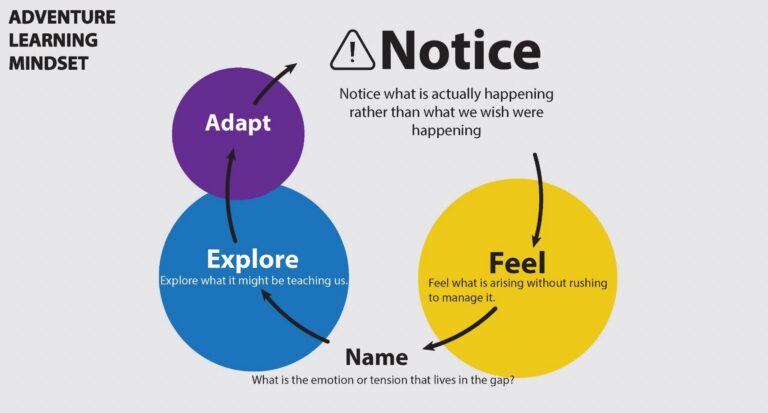
An Adventure Learning Mindset begins with noticing what is actually happening, not what we hoped would happen or planned for. It asks us to stay present long enough to recognize the gap between expectation and reality.
And that gap matters.
Because that’s where emotion lives. Frustration. Uncertainty. Excitement. Discomfort.
These emotions are often treated as problems to eliminate, but they are better understood as signals. They point to needs, to values, to something that matters in the moment. When we can stay with that signal, even briefly, we begin to make sense of what is unfolding rather than reacting to it.
This is where empowerment begins. Not in having the answer, but in building the capacity to understand the moment you are in.
The question becomes:
- Can you notice what’s actually happening?
- Can you feel without immediately reacting?
- Can you name what’s going on inside you?
- Can you explore what it might be teaching you?
- Can you adapt your response?
That’s the skill.
Why Relationships Matter More Than Strategy
Of course, no one navigates that space alone. A student’s ability to stay in the gap is shaped by the support around them. Sometimes they need information. Sometimes encouragement. Sometimes space. Sometimes someone simply acknowledges what they’re experiencing.
Support is not fixed; it shifts based on the person and the moment. Without it, challenges quickly become overwhelming.
With it, the same moment becomes something a student can move through, and learn from.
This is why relationships are not an add-on to the work. They are the condition that makes the work possible.
A student’s ability to stay in that gap depends on support:
- Emotional (someone sees me)
- Social (I’m not alone)
- Informational (I know what to try)
- Physical (I have what I need)
- Esteem (I believe I can do this)
With the right support, challenge becomes growth.
That’s not philosophy.
That’s design.
From Reflection to Action
From there, the question becomes one of action. What will I do with what I am experiencing? Leadership, in this sense, is not about position or title. It is about response. It is the decision to act with intention, even when the outcome is uncertain. Sometimes that means trying again. Sometimes it means asking for help. Sometimes it means adjusting a plan or letting go of one entirely. Over time, a pattern begins to form: something happens, we make sense of it, we respond, we reflect, and we adapt. This is how people learn to navigate complexity, not by avoiding uncertainty, but by practicing how to move within it.
It leads to action through a simple cycle:
- Before: What do you expect will happen?
- During: What’s actually happening?
- After: What did you learn, and how will you use it?
And when something breaks down?
- Analyze
- Brainstorm
- Choose
- Do
- Evaluate
This is how people learn to adapt in real time.
In every classroom, every day, there are moments that don’t go according to plan. A student reacts. A lesson shifts. A tension surfaces. These moments are often treated as interruptions, something to manage quickly so we can get back to what we intended to teach.
But what if those moments are the lesson?
What if the most important thing students learn is not how to follow the plan, but how to respond when the plan falls apart?
At High 5, this question has shaped years of work in our Keene, New Hampshire laboratory schools, and continues to guide the Edge of Leadership framework. The book is one way of capturing that learning. Our professional development workshops are another, spaces where educators can experience, reflect on, and begin to apply an Adventure Learning Mindset in their own context. Because this is not about adding something new to your work. It’s about seeing your work differently.
So before the next lesson begins, it may be worth asking:
Are you preparing students for the plan, or for what happens when the plan no longer applies?