When Control Feels Safer Than Curiosity: Ego, Uncertainty, and Adventure Learning
Written By: Ryan McCormick
I don’t believe people struggle with uncertainty because they lack courage or creativity. It’s more about seeing uncertainty as a threat. Research shows that the brain’s defensive circuits respond strongly to ambiguous or unpredictable danger, what we call in the adventure world, the unknown. For example, Lake and colleagues explain that “anxiety is defined as a state of prolonged fear in response to a threat that is ambiguous or unspecific” (Lake et al., 2011, p. 1). Neurobiological studies of threat anticipation find that core regions such as the amygdala and extended threat networks are activated during uncertain threat, reflecting the brain’s sensitivity to unpredictability (Hur et al., 2020).
When outcomes are unpredictable, the nervous system does not register possibility first; it registers risk. Uncertain threat engages neural pathways that overlap with generalized anxiety responses, and individuals high in intolerance of uncertainty show heightened emotional and physiological responses to uncertainty (Morriss et al., 2021). This neural bias toward threat helps explain why people instinctively try to avoid ambiguity, even when it could lead to learning and growth.
This is where ego enters the picture, not as arrogance, but as a guardian of stability. Ego organizes around a simple psychological question: How do I stay safe, worthy, and recognizable in this moment? When reality stops matching expectations, ego interprets that mismatch as danger, pushing us to restore order quickly, reduce ambiguity, and return to familiar ground. Control becomes a shortcut back to perceived safety.
So when we try to navigate uncertainty, we aren’t just facing the unknown, we are facing the part of ourselves that equates not knowing with not being enough. The tendency to avoid uncertainty and seek rapid resolution is consistent with how the nervous system biases behavior under threat anticipation.
That’s why ego doesn’t just avoid failure; it avoids being seen in uncertainty. It prefers polished certainty to honest exploration and would rather manage outcomes than risk exposure. Ego trades growth for stability not because it is inherently small, but because stability once meant survival.
We are facing the part of ourselves that equates not knowing with not being enough.
Uncertainty also stirs emotion, and emotion is another place where many people were never taught how to stay present. Anxiety, frustration, vulnerability, and excitement often rise together in moments of disruption. Although emotion can provide meaningful information about needs and expectations, many environments have historically framed emotions as problems to fix or suppress rather than as sources of insight. This pattern is reflected in research showing that emotional suppression is associated with greater distress and lower psychological resilience.
Schools and organizations frequently reinforce the illusion that predictability is synonymous with success, correctness with competence, and compliance with maturity. Over time, people learn that uncertainty means something has gone wrong, and the gap between expectation and reality becomes a problem to erase rather than a space to explore.
There is also a social dimension to how people experience uncertainty. Social identity research shows that people become motivated to reduce self-uncertainty, and one effective way of doing that is through group identification (Hogg et al., 2007). When individuals face uncertainty about themselves, affiliation with groups that clearly define norms and expectations can provide psychological stability. This aligns with everyday experience: unpredictability can make people cling to familiar roles, scripts, and communities to regain a sense of self-definition and social belonging.
At the deepest level, what holds people back is the confusion of control with safety. Control feels stabilizing because it reduces ambiguity, but it can also constrict opportunity. Instead, curiosity invites engagement without guarantees. Contemporary research suggests that while anxiety serves an adaptive function to help avoid harmful danger, it also reflects a neural bias toward threat anticipation under uncertainty (Liu et al., 2024). In other words, the nervous system supports both threat detection and potential learning processes, depending on how we attend to what’s happening.
This is why ego and adventure are in natural tension. Ego tries to close the gap. Adventure tries to understand it. Ego says, Fix this so I can feel secure again. Adventure says, Stay here long enough to learn something new.
EOL Tools: Adopting the Adventure Learning Mindset
Within the Edge of Leadership framework, we adopt an Adventure Learning Mindset (ALM). This is not a theory about bravery; it is a set of practices designed to interrupt ego’s reflex to control, replacing urgency with awareness, reaction with reflection, and certainty with curiosity. Tools like the Needs–Values–Expectations Model, ABCDE Problem Solving, Types of Support, and Reflective Practices help learners stay present in the unknown rather than flee from it.
The Adventure Learning Mindset doesn’t try to eliminate the biological impulse toward control. Instead, it gives us tools to slow that impulse down and choose a different response.
The most foundational of these tools is the Cycle of Adventure Learning itself:
Expectation → Reality → Disruption → Reflection → Adaptation.
This cycle functions as a practical map for navigating uncertainty. When something unexpected happens, instead of immediately asking How do I fix this?, the more powerful question becomes: What part of the cycle am I in? That shift reframes confusion as location, “I’m not behind. I’m in the disruption phase.”
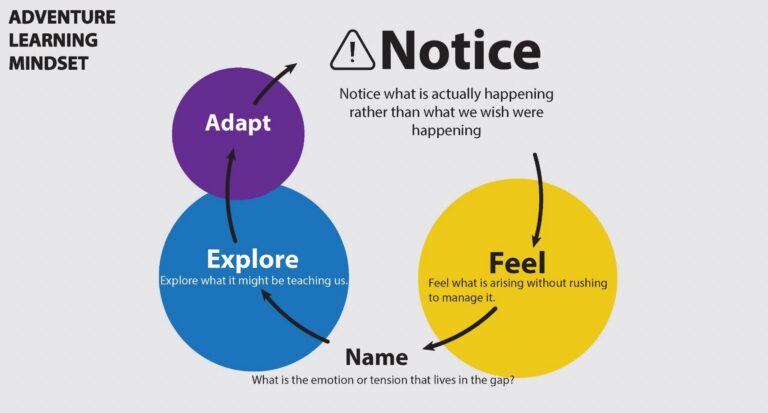
From there, the Notice → Feel → Name → Explore → Adapt sequence becomes a daily reflective practice. We begin by noticing what is actually happening rather than what we wish were happening. We allow ourselves to feel what is arising without rushing to manage it. We name the emotion or tension that lives in the gap. We explore what it might be teaching us. Only then do we adapt, based not on urgency but on deeper understanding.
Adventure learning happens anytime what we expect doesn’t match what actually happens. When that happens, we don’t panic, we pause. We Notice, Feel, Name, Explore, and Adapt. That’s how learners and leaders grow.
The Needs–Values–Expectations (NVE) model becomes the emotional compass inside that process. When uncertainty hits, ego usually points outward: Something is wrong out there. NVE gently turns the lens inward: What expectation was disrupted? What value feels threatened? What need is surfacing right now? Suddenly emotion is no longer an interruption; it is data. Frustration might signal a need for clarity. Anxiety might signal a need for safety. Resistance might signal a need for autonomy. Instead of trying to control the environment, we begin by understanding ourselves.
Once awareness is established, ABCDE Problem Solving gives structure to collective action. It turns uncertainty into a mini-expedition: we acknowledge the gap as the adventure moment, brainstorm multiple paths forward, choose a direction aligned with both learning and purpose, act without certainty, and then evaluate what we learned. ABCDE guards against ego’s rush to the first solution simply to feel competent.
The Types of Support remind us that adventure is never solo. Uncertainty becomes bearable when shared. In moments of disruption, learners can ask themselves: Do I need physical support like structure or safety? Emotional support like validation or calm? Social support like collaboration or belonging? Informational support like feedback or clarity?
Even reflection becomes a tool for ego awareness. Instead of asking Did this go well?, we ask:
- What did I expect?
- What actually happened?
- What emotion told me I was in the gap?
- What did my ego want to do?
- What did adventure invite me to try?
- What shifted because I stayed curious?
That single question, What did my ego want to do?, turns unconscious control into conscious choice.
This is how ego loosens its grip. Ego wants to solve, fix, and stabilize as quickly as possible. The Adventure Learning Mindset insists adaptation is something we earn through awareness, not something we avoid through control.
ALM isn’t about removing fear; it’s about changing who gets to decide. Instead of letting ego’s need for safety dictate behavior, ALM invites curiosity to lead. Instead of seeing emotion as danger, it becomes guidance. Instead of treating uncertainty as a threat, it becomes terrain.
That shift is not just instructional. It is identity-level. It asks people to loosen their grip on control and trust their capacity to navigate. It teaches that worth does not come from being right, calm, or in charge. Worth comes from being present, responsive, and alive in the learning process.
And that may be the most radical thing adventure learning offers:
Not certainty.
Not perfection.
But the courage to stay in the unknown long enough for growth to occur.
Want to learn more about the Edge of Leadership framework?
We have a whole book about it!
References:
- Grupe, D. W., & Nitschke, J. B. (2013). Uncertainty and anticipation in anxiety: An integrated neurobiological and psychological perspective.
- Hogg, M. A., Sherman, D. K., Dierselhuis, J., Maitner, A. T., & Moffitt, G. (2007). Uncertainty–entitativity–group identification: Social identity and self-uncertainty reduction strategies. Journal of Experimental Social Psychology.
- Hur, J., et al. (2020). Anxiety and the neurobiology of temporally uncertain threat anticipation. Journal of Neuroscience, 40(41), 7949–7961. Retrieved from
- Lake, J. I., & Staib, M. (2011). Unpredictability and uncertainty in anxiety. Frontiers in Integrative Neuroscience, 5, 55. https://doi.org/10.3389/fnint.2011.00055
- Liu, X., et al. (2024). A neural signature for the subjective experience of threat under uncertainty. Nature Communications.
- Morriss, J., Bell, T., Biagi, N., Johnstone, T., & van Reekum, C. M. (2021). Intolerance of uncertainty and neural responding to uncertainty of threat. Cognitive, Affective, & Behavioral Neuroscience.