Beyond Posters: Evolving to Our Value Agreements in Experiential Education
Written By: Ryan McCormick
In many experiential education settings, facilitators will invite participants into a process of co-creating a list of shared values with words like; respect, trust, responsibility, and, of course, humor. This is followed up by asking participants to commit to them in a kind of social contract. The list goes on the wall, everyone signs it, and we move forward with good intentions.
But over the years, I’ve noticed something, those lists seem to fade into the background as the real work of the group begins. The words are solid, the intentions meaningful, yet the list doesn’t always shape how the group actually behaves.
I want to be clear, I’m not suggesting anyone has been doing it wrong. These practices have deep roots in our field and have served countless groups well. What I’ve found, though, is that over time, I became more curious about why these agreements sometimes lose their impact, and how we might make them more alive, more human, and more effective.
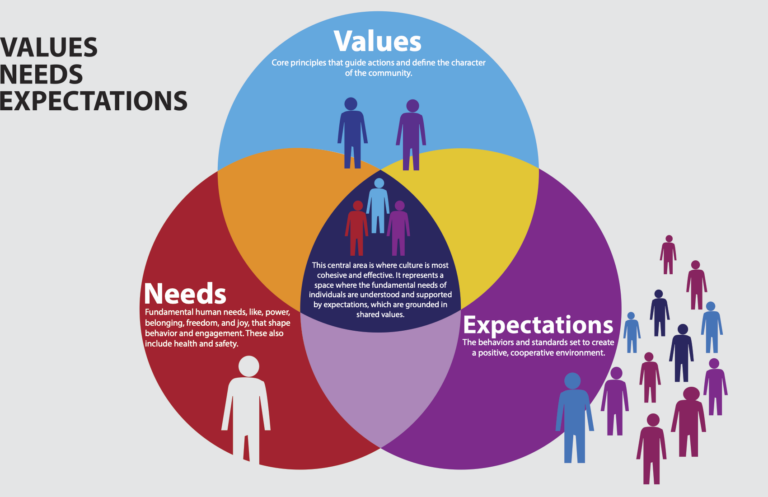
That curiosity has shaped much of my work at High 5 and led to the development of the Edge of Leadership (EOL) Values–Needs–Expectations Model, a framework that helps facilitators explore not just what values are, but why they matter, how they influence emotion and behavior, and how to translate them into meaningful expectations that sustain a healthy group culture.
This didn’t mean we abandoned the practice, it meant we evolved it. Rather than treating values as a separate or symbolic exercise, we began to decompartmentalize them, releasing them from the vacuum of what we thought we already knew. Through our Edge of Leadership (EOL) Laboratory with Keene, New Hampshire Schools (grades 5–12), we started to see, and help students see, the deep interconnectedness between values and developmental needs, and how emotions interact with both to shape our choices and actions. What emerged was a clearer understanding that values aren’t abstract ideals on a poster; they’re personal reflections of universal human needs.
And that realization became the foundation for a shift in how we approach social contracts, classroom culture, and leadership development. When we look closely at what drives our actions, we begin to see that needs and emotions are constantly in dialogue, they inform how we interpret situations, how we respond to others, and how we make meaning in groups.
Values are the personal beliefs that guide how we choose to act, relate, and make meaning in the world. They are not fixed ideals or external rules, but reflections of our core human needs of belonging, freedom, power, joy, and safety. Values give language to what matters most to us and shape the emotions and behaviors that follow.
How Values Develop and Why It Matters
Psychologists have long described values as developmental, formed through lived experience, not simply taught. This is super important, and something I hadn’t considered for much of my early career. However, it’s now at the center of my program design.
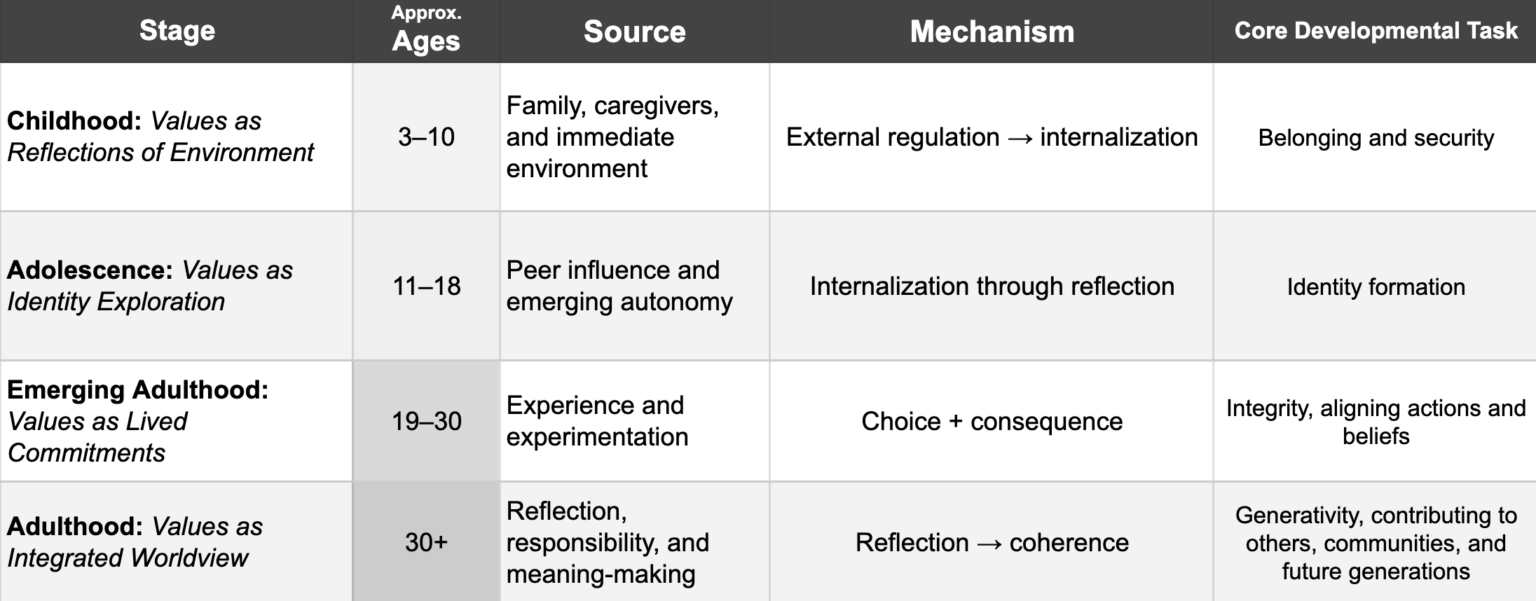
When we bring people together in a group, we’re really bringing together different developmental relationships to values. Understanding that diversity is essential to building empathy and adaptability in group facilitation.
Values reflect the needs driving emotions while shaping behavior… and vice versa.
This is the crux of the EOL approach: When our needs are met, the emotions that surface, pride, joy, calm, satisfaction, act like green lights. They reinforce the behaviors and conditions that helped us get there, strengthening our motivation to repeat them. When our needs go unmet, though, emotions like frustration, fear, or sadness rise to the surface. These aren’t signs of failure; they’re signals, the body and mind’s way of saying that something essential to our sense of safety, freedom, or connection is missing.
In group settings, this pattern plays out all the time. A participant who values autonomy (connected to the need for freedom) might tense up when someone else jumps in to “help,” feeling that their independence has been taken away. Another person who values belonging (linked to connection) might grow quiet or withdrawn when decisions happen without them, sensing that they no longer have a place in the group.
These moments can be easy to misinterpret. To a facilitator or teacher, they might look like defiance or disengagement, but underneath, they’re simply expressions of need. Every emotion, whether comfortable or not, carries information about what helps that person feel safe, respected, and capable within the group.
When we learn to see emotions through that lens, we can respond with curiosity rather than control.
Research in psychology supports this deep connection between values, needs, and emotion. Studies have shown that our values influence how we regulate emotions (Liu et al., 2023), and that emotional experiences, in turn, shape and refine our values over time (Bansal et al., 2023). Deci and Ryan’s Self-Determination Theory (2000) echoes these findings, identifying autonomy, relatedness, and competence as core human needs that, when supported, lead to intrinsic motivation and healthy social engagement.
When we pay attention to these emotional signals, both our own and others’, we begin to understand behavior not as right or wrong, but as meaningful communication. It’s through this awareness that a group learns to move from reacting to understanding, and from managing behavior to nurturing growth.
Culture, Diversity, and Just Values
Over the years, I’ve been fortunate to learn from compassionate mentors who helped me see that values don’t exist in a vacuum. They are shaped, and reshaped, by our culture, community, and lived experiences. What one group calls “respect” or “leadership” can hold entirely different meanings for another, depending on factors like upbringing, race, language, and social context. I’ve come to understand that these differences aren’t barriers; they’re reflections of the diverse stories and environments that teach us what matters most.
Recognizing this is essential for facilitators who want to guide value discussions in just and inclusive ways. As Hofstede (2001) reminds us, cultural values act as “lenses” that shape how people interpret fairness, authority, and belonging. In practice, that means two participants can agree on a value like respect but express it differently, through direct eye contact in one culture and averted gaze in another.
Bias often enters when we assume sameness or when one cultural expression of a value becomes the unspoken “norm.” Without realizing it, facilitators can reinforce dominant (often white, Western) interpretations of values and label other expressions as “uncooperative” or “disrespectful.” This is why cultural self-awareness, noticing our own defaults, is as important as group dialogue itself (Banaji & Greenwald, 2013; Sue, 2010).
A just approach begins with humility and curiosity:
“Our values come from the worlds we’ve grown up in, our families, communities, and cultures. That means we might use the same words but mean different things. Let’s stay curious about that.”
From there, facilitators can:
- Invite multiple truths. Ask what a value looks like in different communities.
- Focus on purpose, not uniformity. Find shared meaning behind varied behaviors.
Co-create behavioral expectations that honor inclusion. For instance, if belonging is a shared value, ensure quieter voices are invited in ways that align with their comfort and communication norms.
Embedding equity directly into the Values–Needs–Expectations map helps create agreements that protect both individual identity and collective safety. Justice, in this sense, isn’t an add-on, it’s built into how we listen, name, and negotiate values together.
Neurodiversity and Values Expression
Just as culture shapes how we express values, so too does neurology, the way our brains process, respond, and relate to the world. Increasingly, educators and facilitators are recognizing that neurodivergence, including ADHD, autism, dyslexia, and other forms of cognitive difference, profoundly influences how participants experience needs, emotions, and behavior in group settings.
Neurodivergent individuals may experience social interaction, sensory input, and emotional regulation differently. For example:
- Someone with ADHD might value freedom and stimulation, thriving in fast-paced collaboration but struggling in long, structured discussions.
- A participant on the autism spectrum might deeply value predictability and clarity, experiencing anxiety or overload when expectations or routines shift unexpectedly.
These differences don’t indicate a lack of values or motivation, they reflect diverse ways of meeting needs. When facilitators understand that behavior is communication, not defiance, they can design group agreements that account for neurological variety just as they do for cultural diversity.
Inclusive practice begins with flexibility:
- Offer multiple ways to participate, verbal, written, visual, or movement-based.
- Provide clear structure and sensory awareness, some participants need quiet reflection time; others need movement or stimulation to focus.
Normalize difference by explicitly naming that people’s brains and needs work in different ways, and that this diversity strengthens the group.
Integrating neurodiversity awareness into the Values–Needs–Expectations Model reminds us that a “living contract” must be accessible to all minds, not just the neurotypical ones.
From Values to Expectations: Making It Functional
The EOL Values–Needs–Expectations Model moves value discussions from conceptual to behavioral. Instead of asking groups to agree on what’s “important,” we ask them to explore what those values look like in action.
Here’s how it works:
1. Personal Values
Begin the conversation by asking students what they believe a value is. Share a brief personal example to model vulnerability and make the concept real. Encourage them to think beyond traditional “school values” and focus on the values that truly matter to them in their own lives.
Invite participants to name one or two personal values and share a story about a time they actively lived one of them. Then guide reflection with questions such as:
- Why is this value important to you?
- What need does it serve, belonging, freedom, power, joy, or safety?
- What emotion lets you know when that need is met or unmet?
These questions help create a foundation of connection and context, allowing each student’s lived experience to bring meaning to the group’s understanding of values.
2. Surface Similarities and Tensions
As the group begins to share their values, patterns and differences will naturally emerge. Some participants will name similar ideas, honesty, kindness, respect, while others will surface less expected values like curiosity, freedom, or humor. This is where the conversation becomes truly rich. Take time to slow down and explore these differences together, not as points of conflict but as opportunities for understanding.
Ask open-ended questions that invite curiosity:
“When you say respect, what does that look like in action?”
“How might freedom and belonging come into tension for us?”
Encourage participants to give examples from their own experience, a moment when a value felt honored or ignored, or when two values seemed to pull in opposite directions. These stories help the group move beyond abstract words into shared meaning.
The goal in this stage isn’t consensus or a tidy list that everyone agrees on, it’s understanding. When a group learns to hold multiple truths at once, they begin to build empathy. This is where trust starts to grow: not in perfect agreement, but in the willingness to listen to and make space for difference.
3. Translate to Behavioral Expectations
Next, the group works together to co-create a list of observable behaviors that bring their shared values to life. This is where abstract ideas become visible in everyday action. The goal is to “connect the dots”, to see how a value (what we believe), a need (what drives us), and a behavior (what we do) all influence how the group functions.
Facilitators can guide the group by asking: “If this value matters to us, what would it look like in action? What would we see, hear, or feel if we were truly living it?” This turns broad concepts like respect, trust, or responsibility into specific, repeatable actions that everyone can recognize and practice.
For example, if we value connection because it meets the need for belonging, then one possible behavioral expectation might be that we include everyone in decision-making. When that happens, people feel a sense of connection; when it doesn’t, they often feel excluded.
Value / Need | Behavioral Expectation | Emotion if Met | Emotion if Unmet |
Belonging | Include everyone in decisions | Connection | Exclusion |
Freedom | Ask before stepping in to help | Pride | Frustration |
Responsibility | Follow through on commitments | Trust | Disappointment |
Invite the group to notice how emotions act as signals. When a need is met, the emotion reinforces the behavior, connection strengthens trust, pride fuels confidence. When a need is unmet, emotions like frustration or exclusion surface, offering insight rather than blame. Encourage students to reflect on these emotional cues during group work: “What might this feeling be telling me about a value that matters right now?” This helps participants recognize that emotions aren’t disruptions to learning, they’re data about what the group values and what needs attention next.
4. Revisit and Reflect
Rather than signing and forgetting, the group revisits its values and expectations regularly, using them as a map that connects daily behavior to deeper needs and shared understanding. This map becomes especially powerful during check-ins after both challenging and successful moments. When tensions rise, facilitators can guide reflection by asking, “Which expectations slipped, and what need or value might have felt unmet?” Equally important, when things go well, such as when the class walks back from PE calmly and without disruption, the facilitator can highlight that success: “We walked safely and in control through the halls because of what values? What needs were being met at that moment?”
This approach turns ordinary routines into teachable moments about how values show up in action. It helps students see that their behaviors, whether in calm or chaos, reflect the invisible forces of needs and values underneath. Over time, these conversations help make the abstract visible, the emotional understandable, and the collective intentional.
By regularly asking questions like:
- “Which expectations did we live up to today?”
- “What emotions told us our needs were met or unmet?”
- “Do we need to adjust anything?”
…the group transforms its value agreement into a living feedback system, one that grows alongside the class and continually strengthens their sense of connection, accountability, and belonging.
Extending the Work: The Language of Expectations Model
This sequence not only helps groups define what their shared values look like in action, it also lays the groundwork for ongoing work with values and expectations throughout the program. Once participants have co-created these behavioral agreements, facilitators are equipped with a shared framework, and the language, to help those expectations stay alive in daily practice.
At High 5, this naturally sets the stage for using Edge of Leadership’s Language of Expectations Model, a simple coaching tool that reinforces positive behavior by connecting expectations back to their purpose. Here’s the formula:
We + Expectation + Purpose = Shared Understanding & Belonging.
It sounds like this:
“We listen when others are speaking so everyone feels heard and valued.”
This structure helps facilitators, and eventually students, understand why the expectation exists, linking it to the underlying value and need that make it meaningful. It turns reminders into relationship-based coaching.
For those of us who grew up hearing, “Hey, you need to sit and listen or lose recess time,” this model offers a kinder, more empowering alternative. It teaches language that builds accountability through connection rather than compliance, grounding behavior in empathy, not enforcement.
Over time, this consistent use of the “WE + Expectation + Purpose” approach helps weave the group’s original agreements into the fabric of classroom or team culture, transforming them from posted words into practiced habits.
This approach brings together lots of ideas, it’s a remix that integrates decades of research from education, psychology, and leadership science. It stands on the shoulders of thinkers and practitioners who have long explored how people learn, connect, and thrive together.
Research on values-based interventions demonstrates that naming and reflecting on personal values increases self-awareness, intrinsic motivation, and accountability (Paliliunas et al., 2021). Studies of classroom norms and expectations show that when students co-create behavioral agreements, they build stronger communities and experience fewer conflicts (Cornell CTI, 2022). Meanwhile, Control-Value Theory (Pekrun, 2014) illustrates how our sense of control and the value we assign to tasks shape our emotional experience, engagement, and ultimately, learning outcomes.
When we understand how values reflect needs and emotions, we gain tools to design group environments that foster empathy, clarity, and mutual respect. In other words, we move from compliance to commitment, from “what we said we’d do” to “how we actually live and work together.” And that shift, though subtle, changes everything about how a group learns, collaborates, and defines success.
A Living Contract and What Comes Next
Over time, I’ve come to see values not as rules to follow, but as relationships to understand. Each participant’s values tell a story about what helps them feel safe, powerful, and connected. By listening to those stories, we create the foundation for real group culture.
This isn’t about replacing old methods, it’s about deepening them. By linking values to needs, emotions, and expectations, and by honoring the cultural, neurological, and human diversity behind them, facilitators can transform a poster of good intentions into a living framework that grows with the group.
At High 5 Adventure, we believe this work shouldn’t stay theoretical. Our professional development workshops explore these ideas in depth through tangible, experience-based activities that bring the Values–Needs–Expectations and Language of Expectations models to life. Participants leave with concrete tools, shared language, and ready-to-use strategies for strengthening classroom, team, or organizational culture.
If you or your organization are looking to make your social contracts more alive, your culture more connected, and your values more lived, we’d love to help you take the next step.
That’s where culture, and real change, truly begins.
Want to learn more about the Edge of Leadership framework?
We have a whole book about it!
References:
- Banaji, M. R., & Greenwald, A. G. (2013). Blindspot: Hidden Biases of Good People.
- Bansal, A., et al. (2023). Understanding the Relationship between Values and Self-Conscious Emotions.
- Cornell University Center for Teaching Innovation. (2022). Establishing Community Agreements and Classroom Norms.
- Deci, E. L., & Ryan, R. M. (2000). Self-Determination Theory and the Facilitation of Intrinsic Motivation, Social Development, and Well-Being.
- Hofstede, G. (2001). Culture’s Consequences: Comparing Values, Behaviors, Institutions, and Organizations Across Nations.
- Kapp, S. K. (2020). Autistic Community and the Neurodiversity Movement.
- Liu, Y., et al. (2023). Values, Emotion Regulation, and Psychological Adjustment.
- Paliliunas, D., et al. (2021). Values-Based Interventions: A Review of Empirical Evidence.
- Pekrun, R. (2014). Control-Value Theory of Achievement Emotions. Educational Psychology Review.
- Sue, D. W. (2010). Microaggressions in Everyday Life: Race, Gender, and Sexual Orientation.
- Tervalon, M., & Murray-García, J. (1998). Cultural Humility versus Cultural Competence: A Critical Distinction in Healthcare Education.