Beyond the Comfort Zone: Rethinking Challenge Through Support
Written By: Ryan McCormick
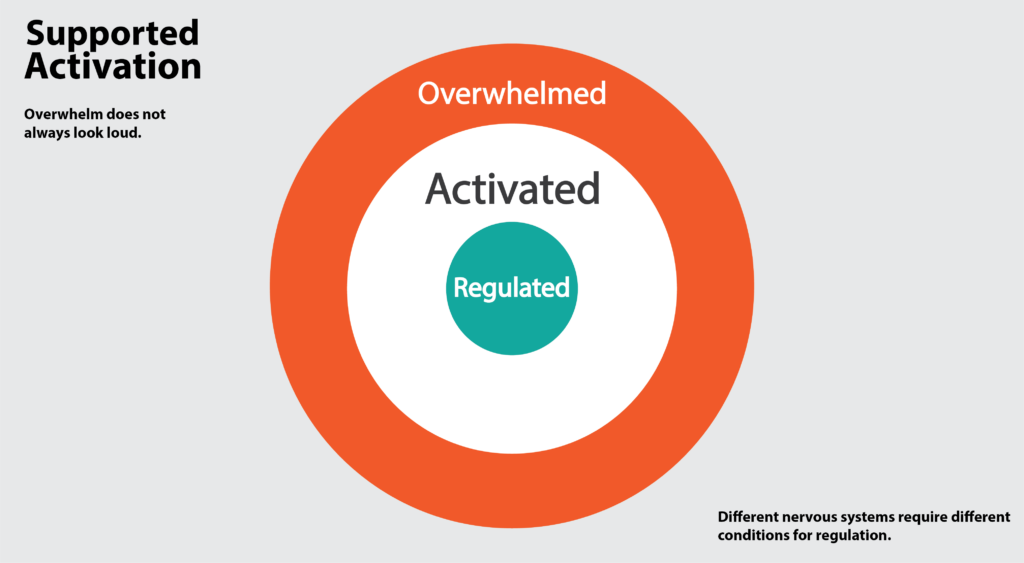
For years, many of us in education and experiential learning have referenced a familiar visual: a set of concentric circles labeled comfort, stretch, and panic. It’s a model that has helped generations of educators think about growth, challenge, and risk-taking. It gave us language for what it means to step into something new.
Often, we bring this model to life in a tangible way. We lay the circles out on the floor with rope, comfort in the center, stretch surrounding it, and panic on the outer edge. Then we offer scenarios and invite participants to stand where they think they would be. Swimming in the ocean. Finding yourself in an argument with a friend.
And to be clear, there is value in that.
However, over time, we began to notice something. The model made sense conceptually, yet it didn’t always hold up when placed against the lived experience of students. It explained part of what we were seeing, but not enough of it to guide our decisions in meaning expanding ways.
The limitation wasn’t that it was wrong. It was that it was incomplete.
The traditional comfort zone model is built on the idea of feeling: comfort, discomfort, panic. It assumes that if we understand how someone feels, we understand their readiness to learn. But in practice, that assumption begins to break down. Two students can both feel uncertain and respond in entirely different ways, needing different types of support. One leans in, takes a risk, and engages. Another withdraws, shuts down, or becomes quiet in a way that looks like compliance but isn’t learning.
What’s happening in those moments is not just emotional. It is physiological. It is relational. It is contextual.
And importantly, it is shaped by a person’s lived experience.
For example, a trauma-informed lens helps us recognize that not all students enter a learning environment from the same place. Some arrive regulated and ready to engage. Others arrive activated, scanning for uncertainty, perceiving risk more quickly and more intensely. And some enter already overwhelmed, their nervous system in a state where engagement is not immediately accessible.
For students who experience chronic stress or high anxiety, the distance between activation and overwhelm can be incredibly short. What may feel like a manageable challenge for one student can quickly become overwhelming for another. This isn’t about willingness. It’s about capacity at that moment.
That realization pushed us to rethink not just the language, but the purpose of the model.
Through our work in the Edge of Leadership (EOL) program, we began to shift toward a model that better reflects these realities: regulated, activated, and overwhelmed.
Regulated describes a state where a student feels safe enough to participate, connect, and process. Activated is where a different learning lives. It is the space of productive challenge, where energy rises, uncertainty is present, and risk-taking becomes possible. Overwhelmed is not failure, but protection. It is what happens when the system no longer feels safe enough to stay engaged.
This shift may seem subtle, but it fundamentally changes the goal.
The goal is no longer to push students out of their comfort zone.
The goal becomes supporting them to stay engaged in the challenge.
That realization did not come from theory. It came from practice.
Through our laboratory work with Keene, NH schools, we saw the same student show up as confident and engaged in one classroom, and more quiet or withdrawn in another, sometimes within the same day. What was changing was not the student. It was the environment, relationships, expectations, and the level of support.
And for many of these students, that shift was happening every 42 minutes.
Every 42 minutes, they were entering a completely new system.
Different peers.
Different teacher.
Different expectations.
Different classroom culture.
In other words, a completely different experience of risk and support.
What we began to understand is that students weren’t struggling with consistency in who they were. They were responding, moment by moment, to the conditions around them. Their capacity to stay engaged, to remain in that activated space, was expanding and contracting throughout the day based on what each environment offered or demanded.
Consistency isn’t just about the student. It’s about the systems we place them in.
More recently, this understanding deepened in a new way on the challenge course.
Over the last few years, I’ve been noticing moments that feel different from what we had typically seen in years past. Students are pushing themselves further, more consistently, and with a level of persistence that stands out.
They move through fear and doubt in visible ways.
They continue through tears and difficult emotions.
They name what they’re feeling.
They ask for support.
And then they try again.
It’s not uncommon now to see a student make four or five attempts at an element, each time moving just a little further. Where their first attempt may have ended after only a few moves, frozen, overwhelmed, and coming down, they return. Again and again, extending what they are able to do.
In many cases, they eventually reach the top.
What struck me wasn’t just that it was happening. It was how often it was happening too.
I found myself asking:
What is compelling them to keep going?
Well, the answer wasn’t about pushing harder alone.
It was about support.
During this same period, we had strengthened our approach to building supportive environments, equipping students with shared language, clear expectations, and tools to understand their internal experiences. We were more explicit about emotions, more consistent in how we responded to them, and more deliberate in how we created conditions for belonging, autonomy, and competence.
What we began to see was a shift toward intrinsic motivation and greater perseverance.
Students weren’t persisting because they were told to.
They weren’t continuing because of external pressure.
They were doing it for themselves and now had the support to stay engaged longer.
When individuals feel safe enough, supported enough, and understood enough, they are more willing to remain in activation. They can experience fear without immediately tipping into overwhelm. They can navigate uncertainty without shutting down.
For some students, especially those who experience high anxiety or who enter already activated or overwhelmed, this shift can be profound. The pathway to overwhelm may still be short, but with the right support, the pathway back to regulation becomes more accessible.
And that is where growth lives. Not in forcing someone further than they are ready to go,
but in creating conditions where they choose to go further themselves.
This also expands how we think about inclusion.
Learners bring different cognitive processes, cultural contexts, and ways of engaging with the world. Some need time. Some need movement. Some need relational safety before participating. Others are navigating internal states that aren’t visible at all.
A fixed model of challenge can’t account for this kind of variability. But a more flexible, responsive model can.
Sometimes, we take it a step further. Instead of asking where someone stands within the circles, we invite them to redraw the circles themselves based on the scenario. What does your “comfort, stretch, panic” actually look like in this moment?
For some, the space between stretch and panic is wide, they can stay with challenge for a while. For others, that distance is much shorter: I can try, but it won’t take much before I’m overwhelmed. And for some, there may be very little comfort to begin with. The scenario itself, sometimes even the thought of it, already feels like too much.
As participants sketch their own versions, the model begins to shift. The circles are no longer fixed. They expand, contract, or disappear depending on the person and the context.
What becomes visible is not just where someone stands, but how differently each person experiences the same moment.
The regulated–activated–overwhelmed framework builds on this understanding. It doesn’t tell us where someone should be. It helps us recognize where they are and respond in ways that make engagement more accessible. It allows us to design environments that are flexible, responsive, and inclusive of different ways of learning, processing, and being.
It also changes how we interpret behavior.
What looks like disengagement may be overwhelm.
What looks like resistance may be protection.
What looks like defiance may be a response to perceived risk or unmet needs.
This shifts the question from What’s wrong with this student? to What is this student experiencing, and what support do they need to stay engaged?
And that shift changes everything.
It moves us from judgment to curiosity.
From control to responsiveness.
From compliance to connection.
This is where the connection to leadership becomes clear.
Leadership, in this model, is not about pushing people harder or expecting them to simply “step up.” It is about developing awareness.
Awareness of self—recognizing one’s own state, needs, and capacity.
Awareness of others—understanding what behavior may be communicating.
Awareness of the collective—seeing how group conditions impact engagement.
Leadership becomes the ability to notice, interpret, and respond in ways that support both individual and group success.
Not about controlling outcomes.
But about shaping conditions.
Because when individuals understand themselves, they gain agency.
When they understand others, they build connection.
And when they can influence the collective, they step into leadership.
Not as a role,
but as a contribution to the group.